Localization and translation ROI: How to optimize investment returns
Other

Table of content

Localization can increase revenue, improve customer experience, and help companies enter new markets. To determine whether these benefits justify the associated costs, businesses need to measure localization return on investment, or localization ROI.
Localization ROI compares the financial value generated through localization with the cost of translating, adapting, managing, and maintaining multilingual content. Translation ROI focuses more specifically on the financial impact of the translation process.
Translation vs. localization: Translation converts content from one language into another. Localization also adapts design, terminology, formats, user experience, marketing messages, sales channels, and other market-specific elements.
The standard ROI formula is:
ROI = ((Gain from investment − Cost of investment) ÷ Cost of investment) × 100
For localization, the gain may include additional revenue, higher conversion rates, increased customer retention, lower support costs, or operational savings in a target market. The investment includes translation, localization software, internal labor, external services, quality assurance, engineering, and ongoing content maintenance.
Calculating localization ROI is more complex than measuring a single product investment because localization affects several teams, markets, and business outcomes. Companies must therefore connect localization costs with both financial results and supporting performance indicators.
The standard ROI formula provides an overall financial result, but it does not explain which markets, languages, workflows, or content types generate the strongest returns. Companies therefore need to combine financial data with operational and market-specific KPIs.
Relevant KPIs depend on the company’s business goals, localization workflow, content type, and target market. They can be divided into three main categories:
translated words, segments, pages, or releases per period
average turnaround time
on-time delivery rate
translation error rate
percentage of content requiring post-editing
translation memory reuse rate
cost per translated word or segment
localized website traffic
organic keyword rankings in the target market
conversion rate by language or region
leads and purchases from localized pages
customer acquisition cost by market
revenue generated in each target market
customer support requests by language
customer satisfaction and retention
product adoption by region
localization turnaround time
internal review effort
time required to launch multilingual releases
Not every KPI can be converted directly into revenue. Metrics such as error rates, turnaround time, and translation memory reuse describe process efficiency rather than financial return. However, they can influence localization costs, release speed, customer satisfaction, and long-term market performance.
The next step is calculating the full cost of localization. Relevant cost categories may include:
salaries and internal team time
freelance translators and language service providers
translation management and localization software
machine and AI translation usage
engineering and integration work
linguistic quality assurance and review
localized marketing and market research
ongoing updates and content maintenance
Teams should also define which department owns each metric. For example, the translation team may complete content on time while a delayed software release prevents users from receiving it. Separating localization performance from engineering, product, and marketing delivery makes ROI analysis more accurate.
Define the financial and operational objectives.
Record all localization-related costs.
Measure the revenue, savings, and performance changes associated with localized markets.
Compare the results across languages, markets, and reporting periods.
Quantitative ROI should also be interpreted alongside qualitative outcomes, including:
brand perception in the target market
customer satisfaction
terminology and messaging consistency
employee and translator experience
collaboration across localization, product, and marketing teams
A company invests €20,000 in translating and localizing its software, website, and marketing content for a new market. During the measurement period, the localized market generates €32,000 in attributable profit.
ROI = ((€32,000 − €20,000) ÷ €20,000) × 100 = 60%
This means the localization investment generated a 60% return during the measured period. The company should still review supporting KPIs, such as conversion rate, customer retention, and localization costs, to understand what contributed to the result.
Companies can improve localization ROI by focusing investment on the right markets, reducing repetitive work, preventing quality issues, and connecting localization directly with product development.
Measuring performance by market and language helps companies identify where additional localization investment is likely to generate the strongest return. Markets can be grouped according to their current performance and growth potential:
Rising stars: these are promising markets that show excellent performance and can provide more profit by adding additional efforts.
Stable directions (cash cow): the markets that are already on their success plateau or growing constantly and slowly.
Undefined (question mark): regions that don’t show stable directions yet.
Decline: markets that do not show growth and demand. For these directions, the optimal approach is to recheck the existing strategy and perhaps develop and launch a new one.
One of the most famous examples of failed business localization is Starbucks’s experience in Australia. Long story short, they spent 23 years and millions of dollars to get the first profit.
You can read more about their case in our article about standardization strategy.
Translation technology can reduce costs and turnaround time by automating repetitive work and reusing existing content. Relevant tools include:
AI and machine translation to generate initial translations for human review
translation memory to reuse previously approved translations
glossaries and style guides to improve terminology and brand consistency
automated workflows to route content to the correct language, translator, or review stage
These tools improve ROI when they reduce manual effort without creating additional correction or quality assurance costs.
Translation errors create additional work for translators, reviewers, localization managers, and developers. Automated quality checks can identify potential issues before content reaches production, reducing correction cycles and release delays.
LingoHub can check factors such as text length, terminology, duplicate content, whitespace, HTML markup, placeholders, punctuation, and formatting. These checks support review workflows but do not replace linguistic evaluation by qualified reviewers.
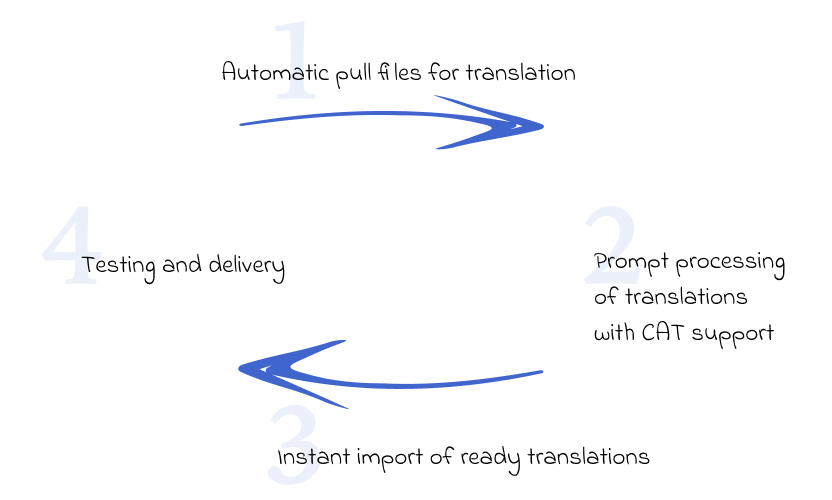
Manual file exchanges and disconnected communication can slow down multilingual product releases. A continuous localization workflow connects translation with product development so that new and updated content can move between repositories and the localization platform automatically.
Repository and CI/CD integrations reduce manual imports and exports, while branch-based localization allows teams to manage translations for separate features, releases, or product versions.
.
Well-built collaboration can improve product quality by around 30%. At the same time, bad communication is often defined as a primary stress factor at work.
LingoHub gives localization participants access to project and segment context within the same platform. Relevant features include:
discussions connected to projects or individual text segments
segment descriptions and contextual notes
glossaries and style guides
translation memories
labels and screenshots that provide additional context for translators and AI workflows
One of the main parts of the ROI-improving strategy is constantly checking progress to notice bottlenecks and issues in time. Additionally, with the data at hand, managers can better build the localization process and predict the deadlines.
LingoHub provides project-level visibility into localization progress, languages, branches, workflow stages, and quality issues. Activity and workflow data help managers identify delayed content, review requirements, and areas where additional resources may be needed.
Localization ROI helps companies understand whether multilingual products and content generate sufficient revenue, savings, or operational value to justify their cost. A reliable evaluation combines the standard ROI formula with market performance, translation efficiency, quality, and customer metrics.
LingoHub helps teams centralize localization, automate repetitive tasks, reuse approved translations, integrate repositories, manage terminology, and identify potential quality issues. These capabilities can reduce manual effort and support more scalable localization workflows.
Try LingoHub for free or book a demo to discuss your localization workflow with our team.
Localization ROI measures the financial return generated by adapting products and content for additional languages and markets. It compares the resulting profit or savings with the total cost of localization.
Use the formula ((Gain from localization − Localization cost) ÷ Localization cost) × 100. The calculation should include all relevant revenue, savings, translation costs, software costs, internal labor, engineering work, and maintenance expenses.
Localization costs can include translators, reviewers, localization software, machine and AI translation, engineering, quality assurance, market research, localized marketing, and ongoing content updates.
Useful KPIs include revenue by language, conversion rate, localized traffic, customer acquisition cost, turnaround time, error rate, translation memory reuse, customer satisfaction, and product adoption by market.
Companies can improve translation ROI by prioritizing the right markets, reusing approved translations, applying terminology consistently, automating quality checks, integrating localization with development workflows, and reducing manual file transfers.
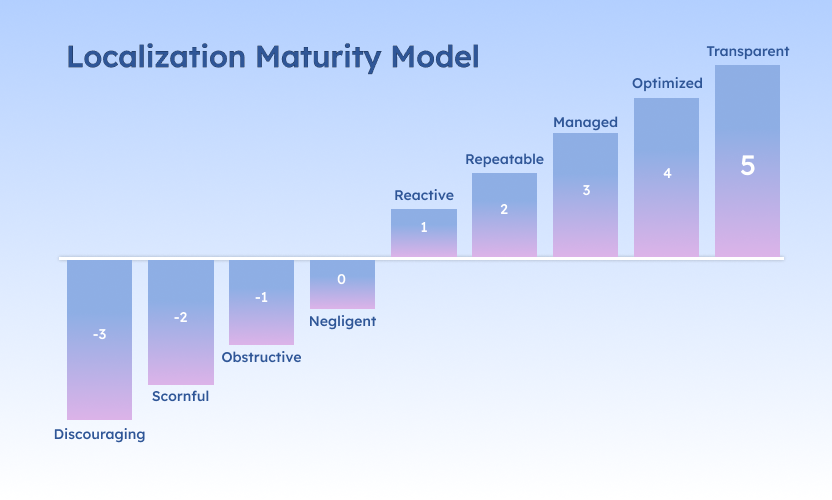
The overview of the localization maturity model
Localization improvement relies heavily on automation, as shown by the maturity model. Read our article to learn how to make localization better.

AI vs human translation: The future in the collaboration
Discover how AI translation performs in practice, where it excels, and why combining AI with human expertise creates the best localization results.

Approaching lean translation management for localization
Discover the lean translation management process. Learn how it ensures agility, speed, and cost savings to optimize your workflows.
