Marketing localization: Adapt content for global markets
Localization strategy

Table of content

Global expansion requires companies to communicate with customers across languages, cultures, and markets. Translating marketing content is part of this process, but effective international campaigns also require adaptation to regional expectations, customer needs, communication styles, and purchasing behavior.
Marketing localization adapts campaigns, messaging, visuals, channels, and offers to a specific language and market. It helps companies communicate more clearly with regional audiences and create marketing experiences that feel relevant to local customers. Its main benefits include:
Build customer trust: 40% of consumers will not purchase from websites that are unavailable in their preferred language. Because marketing content frequently shapes the first impression of a company, it should be clear, relevant, and accessible to the intended audience.
Strengthen market competitiveness: 65% of consumers prefer content in their own language. Localized campaigns can therefore give companies an advantage over competitors that communicate only in English or use direct translations without market adaptation.
Increase engagement: Customers are more likely to interact with marketing content they can understand quickly and relate to. This is particularly important on mobile devices, where users frequently scan ads, landing pages, emails, and social media content within a limited amount of time.
Improve regional visibility: Localized keywords, landing pages, metadata, and content can improve organic visibility in regional search results and help customers discover the company in their preferred language.
A structured marketing localization process helps teams research target markets, adapt messaging, coordinate translators, and improve campaigns based on local performance.
Find out everything about the regional peculiarities: The marketing team must understand all cultural nuances and possible pitfalls to communicate with an entirely new audience.
Build a marketing content localization strategy: You should clearly understand your budget, the amount of content that should be translated, plan the load for the translating team, etc.
Transcreation - build new, relevant messages: First, your team should define which messages can’t be translated directly and which require additional work from the creative side. Slogans, unique selling offers, and advertising do not always resonate with the audience’s pain points and offer relevant proposals. Test the main business messages regarding cultural and other local nuances to prevent spending the marketing budget on initial losing activities.
Read more → Famous products localization overview
Hire a professional translating team: The final result depends mainly on the expertise of the translators you hire, so finding a team that can perfectly fit your business needs is the first step to success.
Track the feedback and provide improvements: Continuously tracking the users’ comments, feedback, and behavior allows for timely implementation advancements to the marketing content and prevents significant failures.
Marketing localization involves creative, linguistic, cultural, and operational decisions. The following challenges can reduce campaign quality and create inconsistent customer experiences:
Misinterpreting cultural context: Symbols, colors, figures, every small detail is important and can be missed when creating local marketing content. A simple example is that in Eastern European countries like Ukraine, an even number of flowers in a bouquet has negative connotations and is associated with funerals and mourning. At the same time, in some countries like the USA, an even or an odd number of flowers don’t have any symbolic implications.
Read more → A picture is worth 1000 misunderstandings
Maintain consistency throughout various content types: The marketing content includes various texts and visuals - ads banners, decks, one-pagers, e-books, emails, social media posts, etc. When localizing, it is essential to guarantee that the tone of voice of the marketing content matches the other business texts, such as the website, sales pitches, UI elements, etc. When adapting marketing content, involving a team of translators is essential, and each of them must clearly understand the target audience and follow the same direction in communicating with it. So, the synchronization of the efforts of all team members is the most challenging part of maintaining uniformity of content.
Constant updates and changes management: The marketing field is one of the most changeable, and new texts, updates of the current campaigns, and additional content arise continuously. To meet the deadline, translators must receive information about newly generated/updated original text. It is especially essential when new features and updates are coming, and the company wants to launch them simultaneously for all regions.
A translation management system can centralize multilingual marketing content, terminology, context, workflows, and quality checks. LingoHub supports marketing teams in coordinating these elements within one localization platform.
Provide linguistic and visual context: Teams can use glossaries, style guides, labels, segment descriptions, screenshots, and translation memories to communicate terminology, tone of voice, visual context, and campaign requirements. This context supports translators, reviewers, and AI translation workflows in producing more relevant results.
Companies can also use professional translation support when content requires additional linguistic or creative expertise.
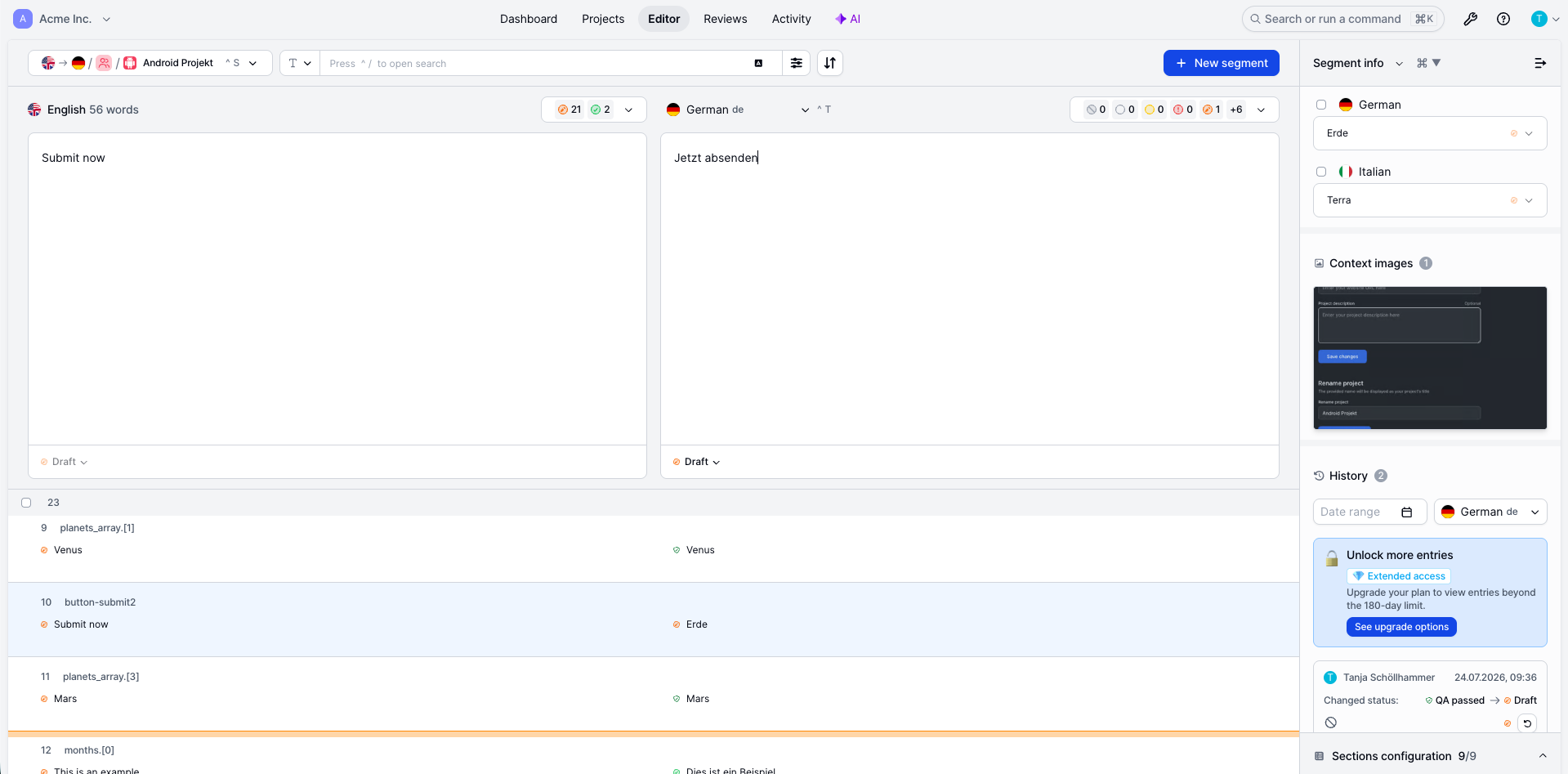
Maintain terminology and brand consistency: Glossaries define preferred translations for product names and key terms, while style guides document language-specific tone, grammar, and writing conventions. Translation memories reuse approved content, and automated quality checks identify potential terminology, formatting, placeholder, punctuation, and length issues.
These tools help teams apply the same language decisions across campaigns without relying on individual translators to remember every rule.
Organize and track multilingual content: Teams can separate websites, campaigns, applications, and other content types into individual projects while managing them within the same workspace. Project views, workflow stages, language assignments, and quality information help localization managers identify content that requires translation, editing, or review.
Marketing localization helps companies adapt campaigns, messages, visuals, and channels to the expectations of specific markets. Successful execution requires market research, qualified language specialists, consistent terminology, clear workflows, and continuous performance analysis.
LingoHub helps marketing and localization teams centralize multilingual content, provide context, maintain terminology, automate quality checks, and coordinate translation workflows.
Try LingoHub for free or book a demo to discuss your marketing localization workflow with our team.
Marketing localization is the process of adapting campaigns, messages, visuals, formats, offers, and communication channels to the language and expectations of a specific market.
Translation converts marketing copy from one language into another. Marketing localization also adapts cultural references, tone of voice, imagery, campaign concepts, channels, formats, and customer expectations.
Companies may localize websites, landing pages, advertisements, email campaigns, social media content, presentations, product materials, videos, and sales content.
Common challenges include cultural misinterpretation, inconsistent terminology, frequent content updates, limited context, unclear responsibilities, and differences between regional language variants.
Relevant metrics include localized traffic, keyword rankings, engagement, leads, conversion rates, customer acquisition costs, revenue by market, and customer feedback.

How to scale international campaigns with marketing translation
Marketing translation helps teams scale 2026 campaigns with AI and human nuance. Learn to choose services and use LingoHub to streamline your workflow.

Market to ideal clients: Interview with Tess Whitty
Read Tess Whitty’s advice for freelance translators on self-marketing, finding the right clients, using social media, and building a career.

Multilingual SEO: How to optimize a website for multiple languages
Learn multilingual SEO best practices for URL structure, hreflang, localized keywords, canonicals, internal links, and international tracking.
