U.S region: Why do the USA companies need localization?
Localization strategy

Table of content

U.S. companies can use localization to reach international markets and multilingual audiences within the United States. Millions of U.S. residents speak languages other than English at home, including Spanish, Chinese, French, and Vietnamese. Adapting websites, software, and marketing content to these audiences can improve customer experience, increase trust, and support business growth. Read more about USA language peculiarities in our blog.
English alone can reach a broad audience, but it does not provide the market-specific experience customers expect everywhere. Localization goes beyond translating words. It adapts content, design, formats, currencies, payment methods, and user experiences to the expectations of a specific market.
This article explains why localization matters for U.S. companies, how leading technology brands adapt their products, and which languages offer strong opportunities for domestic and international growth.
The United States is home to millions of people who speak languages other than English. Providing content in a customer’s preferred language can improve comprehension, build trust, and make products more accessible. Localization is also important for international growth because customers can easily compare global providers and choose products adapted to their language and market. Research on consumer language preferences highlights the commercial impact:
40% of online shoppers will not purchase from websites that are unavailable in their preferred language.
66% use online machine translation or AI translation when content is unavailable in their language.
Localization also helps U.S. companies compete with international businesses that already tailor their products, marketing, and customer experience to regional markets.
U.S. companies also compete with international technology businesses that already adapt products and marketing to regional audiences. The following markets illustrate why market-specific experiences matter.
Chinese technology companies such as Alibaba, Tencent, Huawei, Xiaomi, and ByteDance compete globally across e-commerce, software, telecommunications, consumer electronics, and social media. Their international expansion shows how technology companies can combine product development with market-specific platforms, messaging, and user experiences.
European technology companies compete successfully in specialized markets, with brands such as Spotify, Booking, Nokia, and Ericsson serving international audiences. U.S. companies entering European markets must account for linguistic diversity, local regulations, regional preferences, and established local competitors.
South Korea and Taiwan are influential technology markets with strong companies in semiconductors, electronics, software, and digital entertainment. Products entering these markets require more than English translation because user expectations, writing systems, design conventions, and digital behavior differ from those in the United States.
Localization is the process of adapting a product and its content to the language, culture, conventions, and expectations of a specific market. It can include:
translating product, website, and marketing content;
adapting imagery, colors, layouts, and design elements;
using transcreation to adapt slogans and campaign messages;
adjusting marketing strategies to local audiences;
supporting local currencies, payment methods, date formats, and delivery providers;
adapting software interfaces and user experiences to local conventions.
Localizing products and content can provide several business advantages:
Stronger global competitiveness: Localized products can compete more effectively with regional and international providers.
Deeper market penetration: Content in the local language makes products easier to understand, evaluate, and adopt.
Greater customer trust: Customers are more likely to trust companies that communicate clearly and account for local expectations.
Higher customer loyalty: A consistent localized experience can support retention and long-term customer relationships.
More recommendations: Customers are more likely to recommend products that feel accessible and relevant to their market.
Improved revenue potential: Research published by Harvard Business Review suggests that localization can contribute to sales growth in consumer markets.
TikTok and Douyin illustrate how market adaptation can extend beyond translation. The two platforms differ in content, features, algorithms, and positioning, reflecting the expectations of distinct audiences.
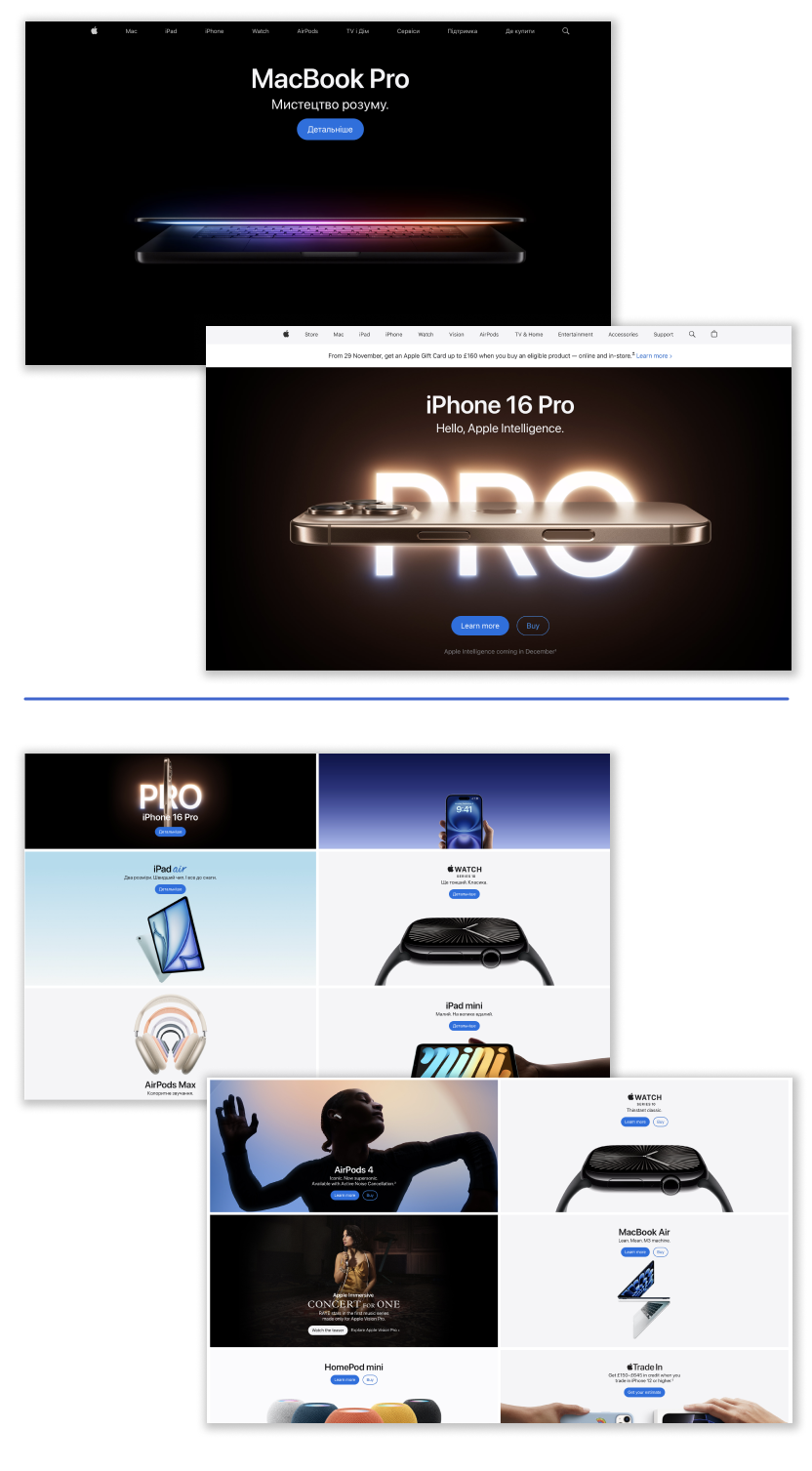
Leading U.S. technology companies adapt their websites, products, and campaigns to individual markets. Even visible differences in homepage content, product placement, design, and promotional messaging show how localization supports their international strategy.
Microsoft adapts its website to individual markets. The pages also use different visual styles and color palettes, showing that localization affects both messaging and design.
Apple maintains localized website versions for countries and regions worldwide, including separate English and French experiences for Canada and English and Spanish experiences for parts of Latin America and the Caribbean. Its UK and Ukrainian homepages promote different products and campaigns, demonstrating that Apple adapts product priorities as well as language. These differences reflect local availability, market demand, campaign timing, and regional customer preferences.
For additional brand localization examples, explore these articles:
Once a company decides to localize, the next step is selecting the languages and markets with the strongest business potential. This decision should be based on customer demand, website traffic, product usage, market size, competition, and expansion goals.
Note: A shared language does not mean that every market requires the same localized experience. Spanish content for the United States, Mexico, and Spain may require different terminology, messaging, formats, and cultural references. Translation provides a foundation, while localization adapts the content to each target market.
Spanish is the most widely spoken language in the United States after English, making it a strong localization priority for companies serving domestic audiences. Spanish localization can also support expansion into Mexico, Spain, Colombia, Argentina, and other markets across Central and South America. However, companies should distinguish between U.S. Spanish, European Spanish, and regional Latin American variants.
Read more: Spanish localization: language peculiarities and challenges
Chinese is one of the most widely spoken languages in the United States and worldwide. It can be relevant for companies targeting Chinese-speaking customers in the U.S. or expanding into mainland China, Hong Kong, or Taiwan. These markets require distinct localization strategies, including the correct use of Simplified or Traditional Chinese, regional terminology, local platforms, and market-specific regulations.
Read more: Chinese, Japanese, Korean: How to localize languages with vertical scripts?
French localization can help U.S. companies reach customers in France, Canada, Belgium, Switzerland, the Caribbean, and several African markets. Each region has distinct terminology and cultural expectations, with Canadian French and European French requiring particularly careful differentiation.
Read more: French localization: language peculiarities and challenges
German localization gives U.S. companies access to Germany and other German-speaking markets, including Austria, Switzerland, Liechtenstein, and parts of Luxembourg. Germany’s large economy and strong software, manufacturing, ecommerce, and industrial sectors make German an important language for international expansion.
Read more: German localization: language challenges and tricks
Portuguese is particularly important for companies expanding into Brazil, the largest economy in South America. It also supports access to Portugal, Angola, Mozambique, and other Portuguese-speaking markets. Brazilian and European Portuguese differ considerably, so companies should localize them as separate language variants.
Read more: The Portuguese language peculiarities during localization
Arabic localization provides access to markets across the Middle East and North Africa, including Saudi Arabia, the United Arab Emirates, Qatar, Kuwait, Bahrain, and Oman. Companies must account for right-to-left layouts, regional dialects, cultural expectations, and differences between Modern Standard Arabic and market-specific language use.
Hindi gives U.S. companies access to a large audience in India and can also support communication with Hindi-speaking communities in the United States. However, India is highly multilingual, so companies should evaluate whether Hindi, English, Bengali, Marathi, Telugu, Tamil, or another regional language best matches their target customers.
Read more: Localization for India - A Fairy Tale of 1,001 languages
Korean localization gives U.S. companies access to South Korea, a digitally advanced market with strong technology, ecommerce, gaming, entertainment, and consumer electronics sectors. Successful localization requires natural Korean copy, culturally appropriate messaging, and interfaces adapted to local digital habits.
The best language depends on the company’s customers, product, and expansion strategy. U.S. businesses should consider:
languages already used by website visitors and customers;
target market size and purchasing power;
existing demand for the product;
local competition;
regulatory and technical requirements;
the cost of translation, localization, support, and ongoing maintenance.
Companies do not need to launch every language at once. A phased localization strategy allows teams to test demand, measure results, and expand based on customer adoption.
Localization helps U.S. companies reach multilingual audiences at home and enter international markets with products that match local expectations. English remains important for global communication, but successful expansion also requires culturally relevant content, appropriate design, regional language variants, and market-specific user experiences.
LingoHub helps companies manage software, website, and product localization through a centralized localization platform. Teams can use:
AI and machine translation for scalable multilingual content;
glossaries, style guides, and translation memories for consistent terminology;
localization workflows and project oversight for managers;
repository and CI/CD integrations for developers;
quality checks and review workflows;
professional translation support.
Try LingoHub for free or book a demo to discuss your localization requirements with our team.
U.S. companies use localization to reach multilingual customers within the United States and adapt their products for international markets. Localization can improve comprehension, customer trust, conversion rates, and market adoption.
Translation converts content from one language into another. Localization also adapts design, terminology, formats, currencies, payment methods, imagery, and user experience to a specific market.
The right languages depend on customer demand and expansion goals. Spanish is frequently a priority for companies serving multilingual audiences in the United States. For international expansion, the right languages depend on target markets, customer demand, product usage, and business goals.
English can reach a broad audience, but it does not replace localized content. Customers frequently prefer products, support, and purchasing information in their own language and adapted to their regional expectations.
Companies should evaluate customer data, website traffic, product usage, market potential, competition, regulatory requirements, and localization costs before prioritizing languages and regions.
Software localization adapts user interfaces, system messages, formats, and product functionality for a target market. Website localization focuses on web content, navigation, SEO, design, and market-specific conversion elements. Many companies need both as part of a broader localization strategy.

GoCardless success story: Easier localization collaboration
Read how LingoHub supports GoCardless with smoother translation workflows for developers and global teams, making collaboration easier and more transparent.

USA: an unexpected treasure chamber in the translation market
Discover the hidden gems of the US translation market. Our blog provides an overview of mobile trends, language diversity, and localization insights.

Why English-only content just won’t cut it anymore
Learn why multilingual content matters and why English alone is no longer enough for businesses reaching diverse audiences across global digital markets.
